The Complete Guide to Agentic AI
Chapters
Summary
This guide will show you what agentic AI is, the benefits of using agentic AI in marketing, and the different ways to make it work for you, along with some examples of what not to do.
Introduction
The growth of agentic AI brings the promise that your teams can scale up not only their tools but themselves by creating a digital workforce composed of AI agents.
These teams can have agents with defined roles, follow defined workflows, and come back to you for direction when necessary.
Across many industries, businesses are discovering the ways in which AI can help scale their business processes to get more done and multiply their team’s productivity.
In this guide, we’ll provide a clear agentic AI definition, explain how agentic AI can work for your business, and show you what to watch out for when deploying it.
Agentic AI chapters

What is agentic AI?
In contrast to earlier AI systems, agentic AI lets you set a task and have the agent figure out how to do it and actually carry it out itself, rather than just generating text or giving you a list of steps.
By comparison, traditional AI and simple chatbots are more recipe-following scripts, albeit complex and powerful ones. However, agentic AI, by definition, has the free agency to decide how to complete a task. It also returns to the user at the appropriate times to ask for more input when there is not enough information to complete the task at hand.
AI agents can truly take action since they have the ability to use tools. In practice, this means calling APIs and invoking commands to make changes, retrieve information, and query systems or the internet.
Agentic AI is a team of large language model (LLM)-powered processes working for you, asking questions, and getting stuff done. They fill in the blanks, do a job, and report back when it’s complete.
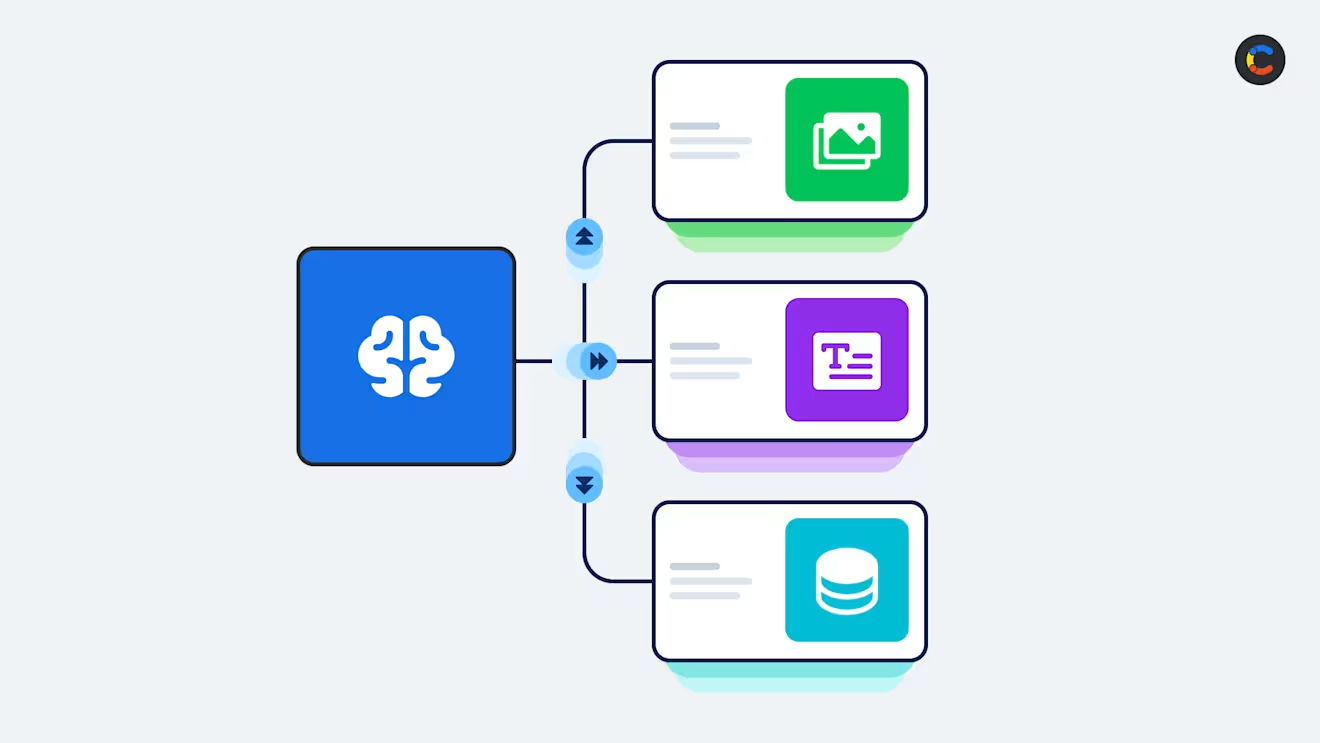
How agentic AI differs from earlier AI
While agentic AI can do many things — and as we discuss here, that list is growing — it’s important to remember that it’s not any of the following:
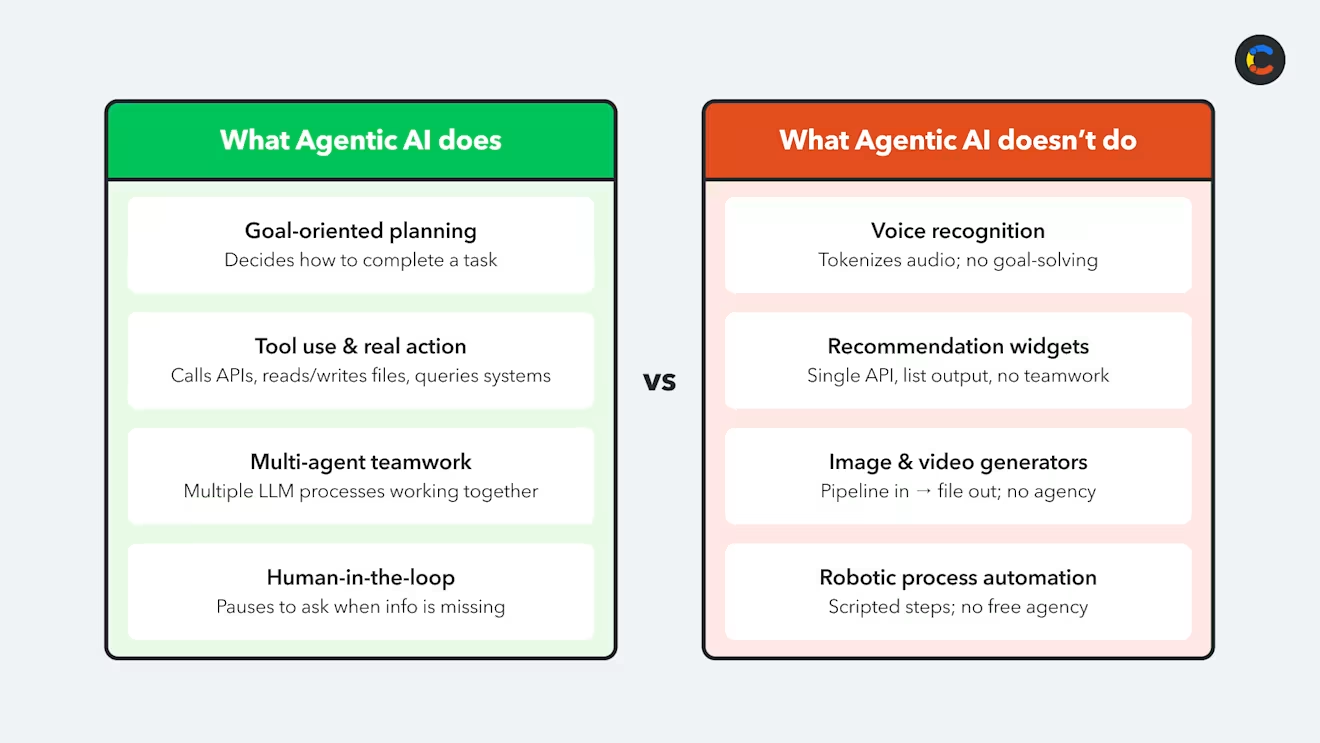
Agentic AI is not voice recognition. Voice recognition is a useful technology you have no doubt used with your phone, watch, or TV, but it’s relatively simple. Modern AI has helped train voice recognition systems to improve them significantly, but it’s still just a process for tokenizing and identifying spoken words in an audio stream, nothing more.
It’s also more than a recommendation tool on webpages, list builders, or other widgets. Your favorite retailers have likely added numerous tools for visitors to receive suggestions and build their shopping lists. These helpers are typically APIs that take in various data sources and produce recommendation lists based on user activity and interests, but they don’t need the power of multiple agents working as a team.
Agentic AI doesn’t generate images and videos but can use services that do. Generators like this are more of a pipeline taking instructions from the user and outputting a file or feed of visual and audible content. They’re powerful and impressive but don’t require the resources of agentic AI tasks and tools.
Robotic process automation is a predecessor to many AI use cases. As such, having your website, desktop app, or phone go through a series of steps to complete multiple tasks is great – it can even look like your device is going off and orchestrating robotic agents to accomplish tasks for you. But it’s not. For example, moving an article through review checkpoints, batch updating it with scripts, and notifying your team when it hits milestones are all useful. However, they are not agentic AI tasks.
And, of course, agentic AI is not a chatbot or a copilot plugin.
AI agents vs. chatbots/copilots
Chatbots
Chatbots are not agents; they are generative AI. While powered by the immense processing capability of an LLM, they’re relatively simple tools that accept questions and give answers, generally targeted at either general conversation or a specific subject. You might find these in desktop or mobile applications, integrated into websites as widgets, or in your standard office tools as plugins. There have been efforts to expand their abilities into tool-using, but they are not agents. The most popular example is currently ChatGPT.
Copilots
Copilots are a different matter because they are more capable than basic chatbots, but they still aren’t agents. Also powered by LLMs, copilots can assist users with an increasingly large number of tasks beyond conversation. But they are without full autonomy, and their conversational ability is directly targeted at a specific task. Think of a copilot like a single-minded coworker or a device that does one job with a chatbot layered on top. A good example is Microsoft’s Copilot, which the company has integrated into its development tools (though it’s more broadly implementing versions across its suite of applications).
Agents
Chatbots and copilots have a number of things in common with AI agents, namely the ability to go out and fetch data, structured or unstructured, via various mechanisms. Two of these are retrieval-augmented generation (RAG), a technique for providing data into a model’s context, and the Model Context Protocol (MCP), which provides access to data and tools. Both of these are typically invisible to the end user.
AI agent vs. agentic AI
The standout feature of AI agents is that they work autonomously, more like coworkers, and make their own decisions on how to move forward. In short, give them a task, and they will go off and figure out how to make it happen. Chatbots and copilots do not have this freedom because they start with a specific set of directives already written into their overriding prompt that dictate how they work. Agents, on the other hand, build their direction of work during a planning stage and work from there.
Agentic AI systems are systems that use AI agents to plan, make decisions, and carry out complex tasks to achieve an overarching goal. These terms are often used somewhat interchangeably, but generally, the agent is the thing doing the work, while the agentic AI system is composed of agents.
How agentic AI works
The agent is a loop running on your computer or a server. It uses an LLM to collect information relevant to the task you give it. To achieve its goal, it reasons (the AI equivalent of thinking and understanding) and plans the steps to get there. It then takes action, either with or without human intervention, and finally evaluates the result to improve future tasks.
It’s increasingly popular to build an agentic AI system from a team of agents, often with a primary agent acting as the organizer.
When agents work together, it’s called a multi-agent system. It’s used as a solution to the limited context windows of individual agents and allows each agent to perform specialized tasks. Ultimately, while one agent handles organizing the others, they all work together toward the same goal.
While the terms for agent teams are still evolving, as is the technology, individual agents have their own working memory (often called "context") and long-term memory (often called storage). The team also has a shared memory.
The major benefit of using a team, other than having customized agents built for specific tasks, is that as the limited context of one agent nears capacity, another agent can replace it. This improves scalability and fault tolerance but relies on the shared memory and handover mechanism.
Read how platforms like Contentful help with agentic architecture in content workflows.
Benefits of agentic AI
We find ourselves engaged more with the work when agentic systems handle the boring tasks for us. This naturally improves productivity and engagement, whether the user is an employee, client, or potential customer.
Agentic AI can complete whole workflows that humans find boring and repetitive — this is what they are best placed to handle. Any repetitive task with a clear guide to follow is a job you can give an agent. While they can handle creative thinking, they come into their own when they free us up by taking the repetitive and meticulous work off our hands.
The massive processing capacity of agentic systems allows a human user to consider a much greater number of possibilities and sort through them faster.
Marketing use cases
For marketers, agentic AI has broad use across:
Research
An agent can accept a directive to perform discovery on a particular topic and follow any avenue on the subject, likely uncovering much more than a human would in the same time. When given constraints and guidance on the types of sources to accept, biases to avoid, and depth to go to, it can research pretty much any subject with an open mind.
Personalization
Whether in-app or online, personalization allows your brand to lean into your customers’ trends by tailoring your offerings and communication with them. Given your in-house branding and dataset, agents can track visitor activities to produce a more nuanced experience than traditional list building and linking can achieve. With integrations into your various services and knowledge bases, an agent may decide to promote via email rather than dropping ads on a page for your visitor — whatever might be more in tune with their behavior and preferences.
Read our in-depth coverage on personalization.
Company | Khan Academy |
|---|---|
AI Agent | Khanmigo |
Purpose | Tutor and teaching assistant. |
Development | Trained on the academy’s library of teacher-vetted educational content across numerous subjects and tailored to guide students in finding answers for themselves through the Socratic method. |
Rollout | Announced and piloted in 2023, with student expansion and global partnerships throughout 2024. |
Benefit | Over 700% year-over-year growth in reach from 2024 to 2025 and rapid teaching adoption. |
Metrics collection and monitoring
While typical metrics and alerting systems follow strict rules, an agentic system can proactively monitor and consider whether a given trend or event might need to be escalated to admins or leadership. This can happen as the system learns your environment and adapts to include or exclude other signals in real time. Dashboards need not be a one-stop shop for anyone using the system because the agent can drill down into significant metrics to provide extra context based on the individual user’s priorities or requirements.
Software development
Agentic AI tools can significantly enhance software development by making use of the numerous technical APIs and utilities that developers already leverage in their day-to-day work. By integrating into build and deployment pipelines, development environments, and debugging tools, a developer is well placed to make good use of agentic teams throughout the development life cycle. They can streamline and enhance everything from the creation of new code to debugging, logging, and failure identification.
When prompting agents for human interaction, consider the user: Are they technical? Do they need a friendly face? Or are they expecting an authority on a given subject?
Agentic AI has many ways of taking action and making use of tools. Agents are often designed (prompted) specifically to make use of particular tools, such as the ability to read and write files or make API calls. One increasingly popular mechanism is MCP, which is a standardized API interface wrapper, something of a Swiss Army knife for AI. This wrapping allows an agent to integrate with an API or application and utilize its functions as if it were directly integrated by a developer.
The importance of structured content for AI agents
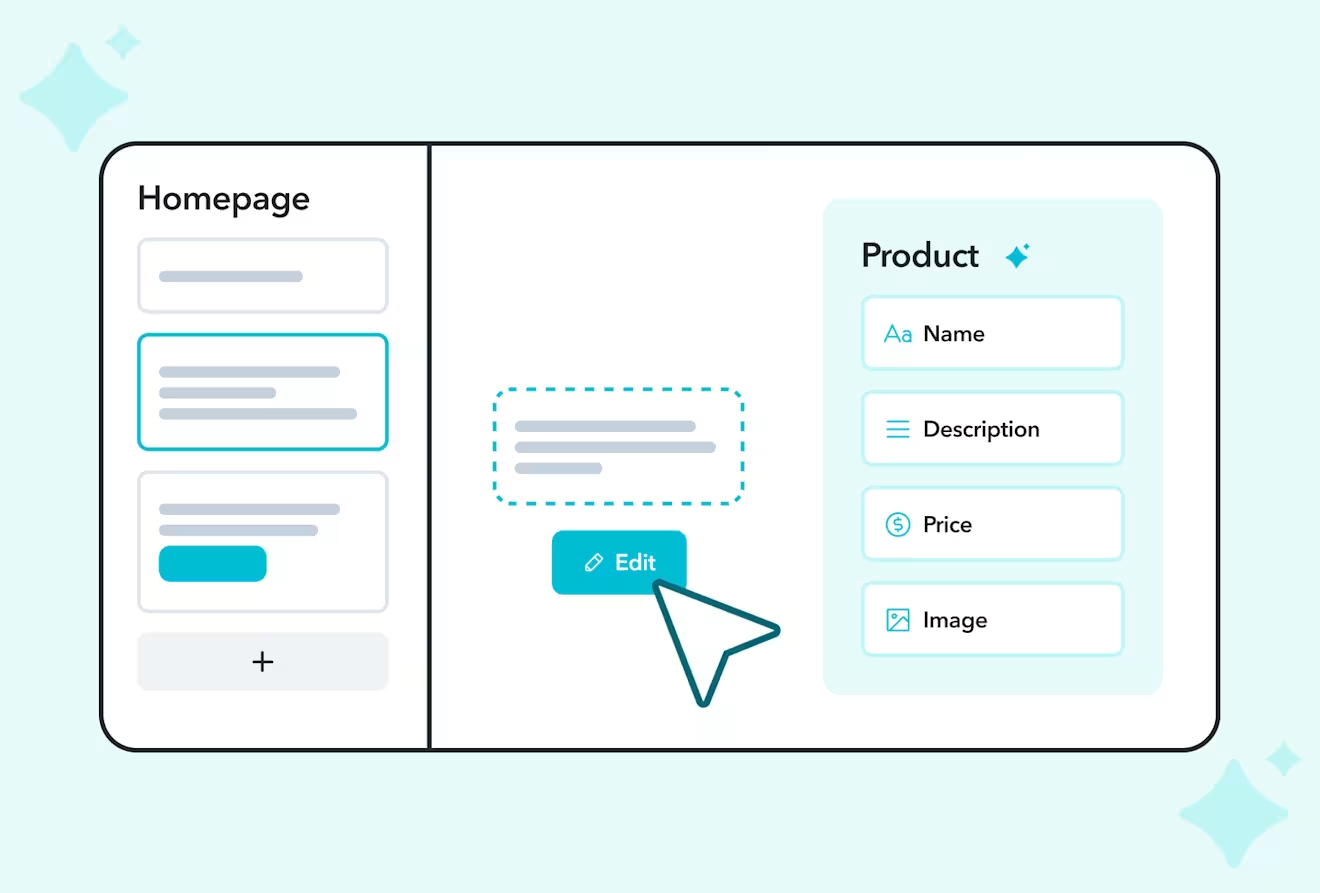
When thinking about the content you intend to provide to your agents, remember that unstructured content breaks agents. Agents need structured data to be consistent and build coherent responses. So, be sure to convert data that is either unstructured or incompatible with internal processes into a logical and related hierarchy of content that can be traversed and interpreted as relatable entities.
With control of structured content comes governance: Who approved the content? When does it expire? What is the agent allowed to do? This is important because it provides the agents with guardrails that keep them from going off course.
These guardrails should be paired with human oversight and approvals. When your agents have a lot of autonomy, it’s still possible for even careful guidelines to fail to keep their output within your brand. At a minimum, ensure a human is involved in checking their output. This includes guardrails that provide rules allowing agents to check themselves and ask for guidance where necessary.
Structured content platforms such as Contentful can help support your content layer for agentic systems.
What are the risks with agentic AI?
When it comes to prompt engineering and AI governance, Contentful can help.
The rules and guidelines mentioned above will help you avoid the risks that come with agentic systems. As discussed, these are not your everyday chatbots and, as such, come with a greater responsibility of control.
The first thing you need to be aware of is the cost: The days of free and cheap AI responses and actions are over because AI – including agentic AI – requires a lot of processing capability. This work is calculated and charged by the ‘token’, which is each word or batch of words, sent to and received from an AI service. As of June 2026 the pricing models for calculating how much customers are charged for this work are going up as AI companies are now increasing their rates, which is catching some users out. So, be mindful of how much you use and how verbose you are with your prompts/instructions.
You’ve probably heard of AI hallucinations — like when a chatbot makes up some event or fact. In agentic work, this can be the result of incomplete or conflicting data — another reason to keep your content structured.
If an agent takes a bad action after a misunderstanding (e.g., bulk updates, sending emails), things can go wrong quickly, so you must take security seriously.
Highlight box: A widely publicized example of agentic AI going wrong
Claude deleted company codebase: The Claude-based AI agent was given too much power and deleted all the code for a small startup company in seconds.
Agents typically mishandle credentials: Research shows that AI agents load all the files they’re given and can write code that leaks this information.
A well-structured and prompted agent, built with the right controls around its API access and tooling, should either have a user validate it or have limits on its destructive capabilities. And, of course, anything it has access to should have auditing to allow rollback if necessary.
This also highlights the need for permissions to prevent issues. For example, if an agent can send emails, a sensible gate to implement would be either a templating system or human review to ensure it doesn’t reveal sensitive business data to the wrong person.
Of course, it’s possible for coordination failures between multiple agents to occur. Preventing this comes down to shared memory, clearly defined roles, and a central organizer between the agents. Agents should communicate with well-structured messages, rather than human-style free-form text, for absolute clarity.
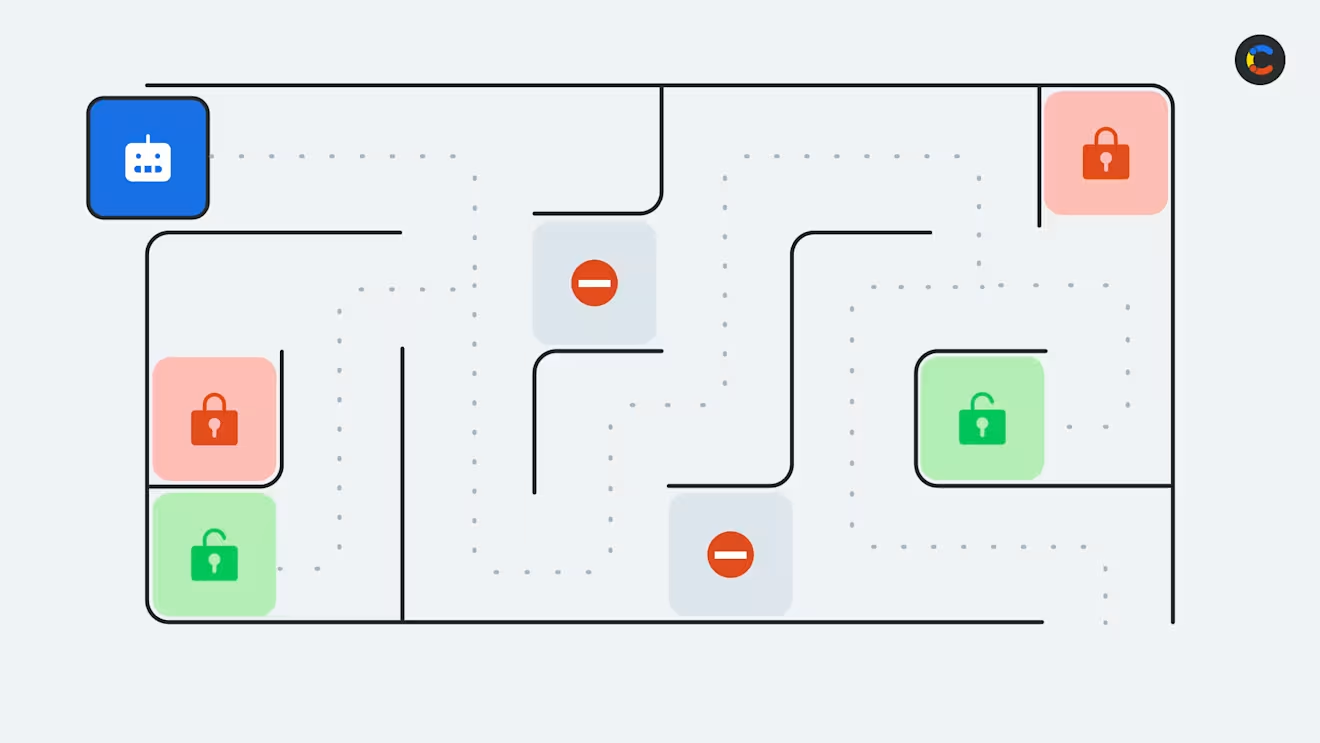
Best practices to avoid agentic AI problems
Let’s recap a list of approaches to implement a successful agentic AI strategy:
Always keep a human in the loop, especially for irreversible actions like sending emails. Gated checks and asking for input when necessary should be baked into prompts.
Agents should operate with a least-privilege principle, so don’t give agents and their APIs access to do more than they need, like key card access at a high-security office.
Provide structured data to ensure agents are working with high-quality data to make accurate decisions and not leave them guessing.
Define clear objectives and guardrails to keep the agents on task and in line. Build in audit logs, and make sure you can roll back changes if the worst happens.
Implement monitoring and logging, from having the agents explain their reasoning and actions to tracking the actions and changes they make.
Be aware of the risks because this is still an emerging and evolving field.
How to get started
Developing your approach to integrated agentic AI requires your business to answer a number of questions. Considering where you want to deploy it, who the target audience is, and how it will mature as part of your roadmap are all important questions you’ll need to answer.
Before jumping in, it’s useful to consider the following readiness assessment:
Content model readiness: Is your model structured? This involves linking related data and knowing whether agents will be able to uncover the underlying meaning in your knowledge base.
Delivery readiness: Can agents access the content, or is there work still to be done? For example, do you need an MCP server put in place, and is there an API for it to wrap?
Governance readiness: Is your data tightly controlled? Will you need good audit tracking? Is there content that needs approval before it can be revealed, and is it versioned? Agents will need this information, and their access to it will likely need to be controlled.
Rollout plan: How will your agentic system be deployed to your users? Ensure that the features and integrations are manageable and that you have an upgrade plan.
Understanding where you want to go with AI agents, the benefits your customers can reap, and how to build a solid strategy will put you on the path to success.
Ready to transform your team with AI agents? Get in touch with our team to begin building your content-driven digital experiences with Contentful.
Up next: Agentic AI tools
This is an example up next